 |
 |
|
 |
 |
| |
|
|
|
|
| Home |
| General Information |
| Sponsors |
| General Rules |
| Registration |
|
2015 Events |
| Think or Sink |
| Katapult Range |
| Pasta Bridge |
| Egg Catcher |
| Small Higgs Boson |
| Laser Maze |
| Physics Bowl |
| Schedule |
| FAQs |
| Awards |
| 2015 Winners |
| Acknowledgements |
|
Website visits since Jan 23, 2015: |
Check this page for updates.
Faculty Coordinator: Roseanne Sension
Preparation Team and Judges: Jiaxing Wu
Event Description:
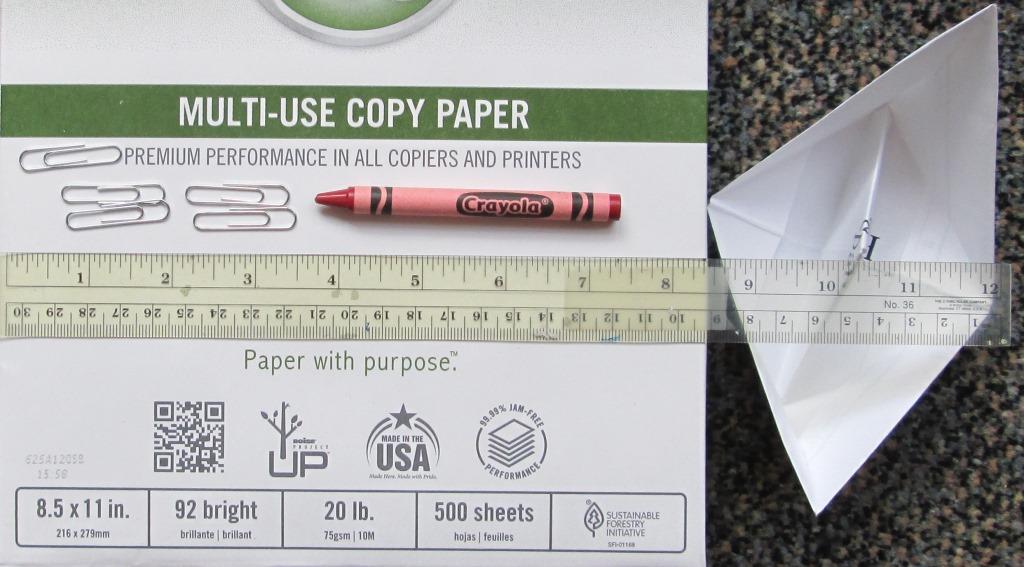 Teams of two students will design a floating device made from a single paper sheet and up to five paperclips (optional). The materials, shown in the picture, will be provided by the organizers. The paper boat will be constructed on-site. Upon completion, its ability to carry a load will be assessed by inserting the boat into a water tank filled with additive-free tap water. Students will add pennies and other calibrated weights to the boat until it sinks. The image shows the building materials provided. A theory quiz will test knowledge on buoyancy, density, pressure and surface tension.
Event Location and Time:
Randall Room 1412.
10:30AM - 11:50AM and 1:00PM - 2:50PM
Apparatus and Materials:
One sheet of letter-sized paper (area = 8.5 x 11 inches). The paper is multi-purpose copy paper (density 75gsm = 75 grams per square meter).
Five regular-sized (#1) paper clips for optional use (Mass per paper clip = 0.37 gram).
One Crayola crayon stick.
Pennies and calibrated weights.
Prior to the competition:
Contestants will develop and optimize a design prior to the competition and practice rapid and flawless fabrication. Another important part is a well thought-through testing porocedure (see Hints and Tips). Contestants will also prepare for the theoretical quiz.
During the competition:
Contestants must construct their paper floating device with the materials provided. The pennies and weights will also be provided.
Event Rules:
Judging Criteria:
Hints and Tips for Competitors:
|
Olympiad Contact Information |
The University of Michigan. All rights reserved. |